A Visual Guide to the Universe by Alberto Hernández Pamplona
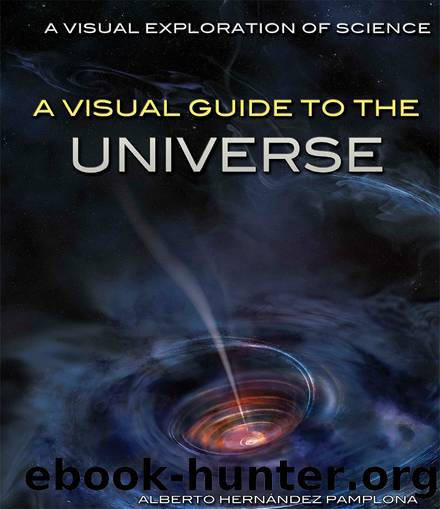
Author:Alberto Hernández Pamplona
Language: eng
Format: epub
Publisher: The Rosen Publishing Group, Inc
* * *
Glossary
Annihilation
Total destruction of matter in a burst of energy, as when it encounters antimatter.
Antigravity
Hypothesized force, equal to gravity and diametrically opposed to it.
Antimatter
Matter formed from subatomic particles with shared properties. Its electrical charge is opposite that of normal matter.
Aperture
Diameter of the main mirror of a telescope or eyepiece. The larger the aperture, the more light the device receives.
Aphelion
The point in a celestial body’s orbit farthest from the Sun. The Earth reaches aphelion on or about July 4, when it is 95,000,000 miles (152, 600,000 km) from the Sun.
Apogee
The farthest position from the Earth reached by the Moon or any of the artificial satellites that orbit the planet.
Asteroids
Minor bodies of the solar system, formed by rock, metal, or a mixture of both. Most asteroids orbit the Sun between the orbits of Mars and Jupiter. Their size ranges from dozens of feet to hundreds of miles.
Astrolabe
Ancient astronomical instrument for measuring both the positions and the movements of celestial objects.
Astronomy
Science that studies the universe. It is concerned with the physical characteristics, movements, distances, formation, and interactions of galaxies, stars, planets, moons, comets, asteroids, and other celestial bodies.
Atmosphere
Layer of gas retained around a planet by its gravity. It is also the outer layer of matter in a star, where the energy produced in the star’s interior is emitted in the form of radiation.
Atom
The smallest part of an element that partakes of all the element’s properties. It is generally composed of three subatomic particles: the neutron, the proton, and the electron.
Aurora
Luminous phenomenon, with red and green layers, visible in the skies of the polar regions. The auroras are caused by the collision of solar particles with the Earth’s atmosphere.
Austral
Related to the Southern Hemisphere.
Big Bang
Cosmological theory asserting that the universe began to exist as a result of a great explosion that occurred some 14 billion years ago.
Big Crunch
Cosmological theory asserting that the universe would undergo a final, complete collapse if it were to begin to contract.
Black Hole
Celestial body so dense that not even light can escape its gravity.
Black Hole, Stellar-Mass
Black hole produced by the explosion of a massive star as a supernova. Its mass is typically about 10 times that of the Sun.
Black Hole, Supermassive
Black hole located at the center of a galaxy and formed by material that falls into the central region of the galaxy. Its mass can be a billion times that of the Sun.
Carbon
One of the most common elements in the universe, produced by stars. All known life is carbon-based.
Chromosphere
The lowest layer of the Sun’s atmosphere. It emits a pinkish-red light that can be seen only when the brighter photosphere is obscured during a total eclipse.
Circumpolar Star
Any star always visible to an observer on the Earth as it rotates about the celestial pole.
Comet
Object made of ice and rock dust. When a comet approaches the Sun, the growing heat causes the ice to evaporate, forming a gaseous head and a tail of dust and gas pointing away from the Sun.
Constellation
Group of stars in the sky. Constellations tend to bear the names of mythological characters or creatures.
Download
This site does not store any files on its server. We only index and link to content provided by other sites. Please contact the content providers to delete copyright contents if any and email us, we'll remove relevant links or contents immediately.
The Rise and Fall of Senator Joe McCarthy by James Cross Giblin(5280)
Paper Towns by Green John(5191)
The Giant and How He Humbugged America by Jim Murphy(3448)
The Science Book (Big Ideas Simply Explained) by DK(3287)
Eleanor & Park by Rainbow Rowell(3175)
The President Has Been Shot!": The Assassination of John F. Kennedy by Swanson James L(3102)
The Rape Of Nanking by Iris Chang(2824)
Merriam-Webster's Collegiate Thesaurus, Second Edition by Merriam-Webster Inc(2760)
Harry Potter and the Deathly Hallows (7) by J.K. Rowling(2725)
Ancient Worlds by Michael Scott(2688)
Beautiful Oblivion by Jamie McGuire(2608)
Eligible by Curtis Sittenfeld(2585)
Dork Diaries 12 by Rachel Renée Russell(2366)
Sharp Objects by Gillian Flynn(2304)
The Unlikely Pilgrimage of Harold Fry by Rachel Joyce(2273)
Frankly, Frannie by AJ Stern(2210)
The Astronomy Book by DK(2157)
Forensics by Val McDermid(2094)
Who Was Louis Braille? by Margaret Frith(1982)
